


Automation in Practice
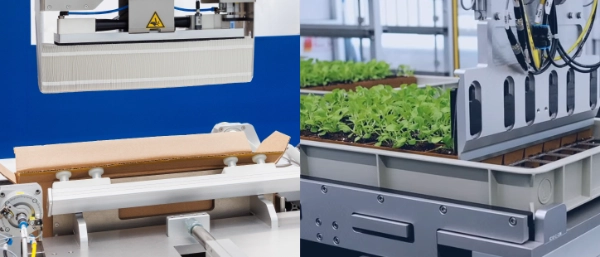
Many processes are already automated – yet critical gaps often remain manual. Our examples show how these gaps can be addressed in a targeted way.
Surrounding Automation in Pharma Packaging: Magazine Feeding of Folding Cartons
From pallet to magazine - and beyond.
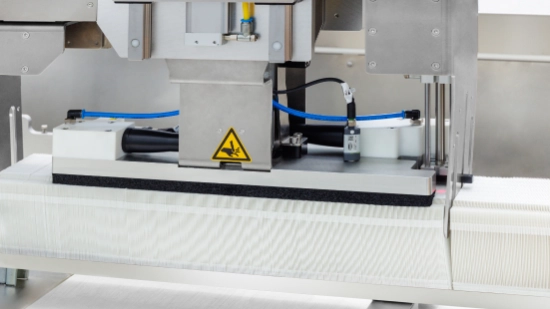
From manual loading to continuous, automated supply
In pharmaceutical packaging, even highly automated lines often depend on manual processes at critical points. One of these is magazine feeding. Folding carton blanks are typically supplied in shipping cartons, requiring operators to lift, unpack and manually refill magazines.
This creates a bottleneck in otherwise optimized processes. It introduces variability, increases physical strain on operators and limits the potential for continuous, stable production.
Automating the flow from pallet to cartoner
To address this gap, magazine feeding can be fully automated – from pallet handling to precise loading of the cartoner magazine.
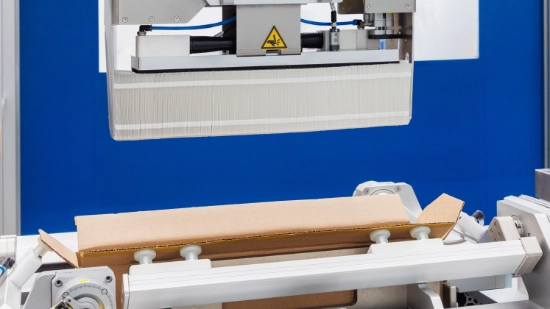
Pre-packed folding carton blanks are taken directly from pallets, the shipping cartons are automatically opened, and the blanks are transferred into the magazine in a controlled and consistent manner. The system can cover the entire material flow, including pallet supply, magazine loading and the handling of empty cartons and interlayers.
By removing manual intervention, the process becomes predictable and continuously available.
Reliable handling of sensitive packaging materials
Folding carton blanks require careful handling to ensure consistent quality and reliable downstream processing. Dedicated gripping and handling technologies enable precise manipulation of the blanks while maintaining process stability.
At the same time, compact system design allows integration into existing packaging lines, even in space-constrained environments. This makes it possible to upgrade existing lines without fundamentally changing their layout.
Ensuring process stability and traceability
Automated magazine feeding ensures a constant and uniform supply of the cartoner, reducing interruptions and stabilizing overall line performance.
In addition, material data such as batch information can be automatically captured and verified against production data. This ensures that the correct packaging material is always in use and supports compliance with pharmaceutical requirements.
Reducing operator workload while increasing performance
Manual magazine loading is physically demanding and repetitive. Automating this step not only reduces strain on operators, but also allows them to focus on higher-value tasks.
At the same time, the combination of consistent material supply, reduced human intervention and integrated data verification leads to a more robust and efficient packaging process.
Closing a critical automation gap
Magazine feeding is a typical example of a process step that has long remained manual despite increasing automation in pharmaceutical packaging.
By automating this interface, it becomes possible to further stabilize production, improve efficiency and move closer to largely autonomous packaging operations.
Automation in Agricultural Science: Sample Preparation and Seed Handling
Precision at the smallest scale
Agricultural research plays a critical role in ensuring the global supply of food. Increasing demands on crop yields, resilience and sustainability require highly controlled and scalable R&D processes.
At the same time, many of these processes operate at the smallest scale – from handling individual seeds to preparing biological samples – where precision and reproducibility are essential.
From manual handling to controlled, automated workflows
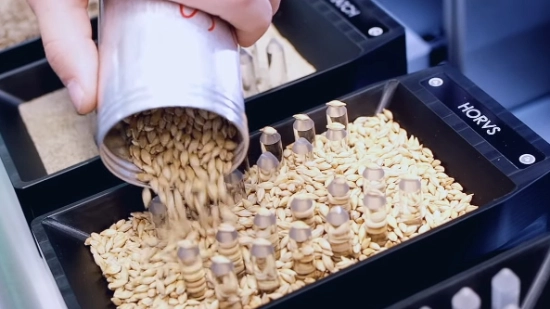
In seed development and crop science research, workflows often involve the handling of individual grains. These must be reliably singulated and transferred into defined formats such as well plates for further analysis.
Automation enables a controlled and repeatable process: seeds are precisely separated, transferred and positioned. In addition, materials such as soil, sand or liquid media can be dosed automatically depending on the experimental setup.
This creates a consistent foundation for downstream testing and analysis.
Standardizing complex biological processes
Beyond seed handling, agricultural R&D frequently involves the preparation of plant samples and the interaction with living organisms.
This includes tasks such as the extraction of leaf segments or the controlled addition of beneficial insects or pests for testing purposes. These steps are typically manual, highly sensitive and difficult to reproduce consistently.
Automated systems make it possible to standardize these processes, ensuring consistent conditions across large numbers of samples.
Scalability through reproducibility
By reducing manual intervention and increasing process consistency, automation enables higher throughput without compromising quality.
Experiments become more comparable, results more reliable and workflows easier to scale – all of which are essential in modern agricultural research environments.
Enabling the future of crop science
Automation in agricultural science is not just about efficiency. It is about enabling research at the level of precision and scale required to develop the next generation of crops.
By structuring and stabilizing complex laboratory processes, automation supports faster innovation cycles and contributes to meeting one of the most fundamental challenges of our time: feeding a growing global population.